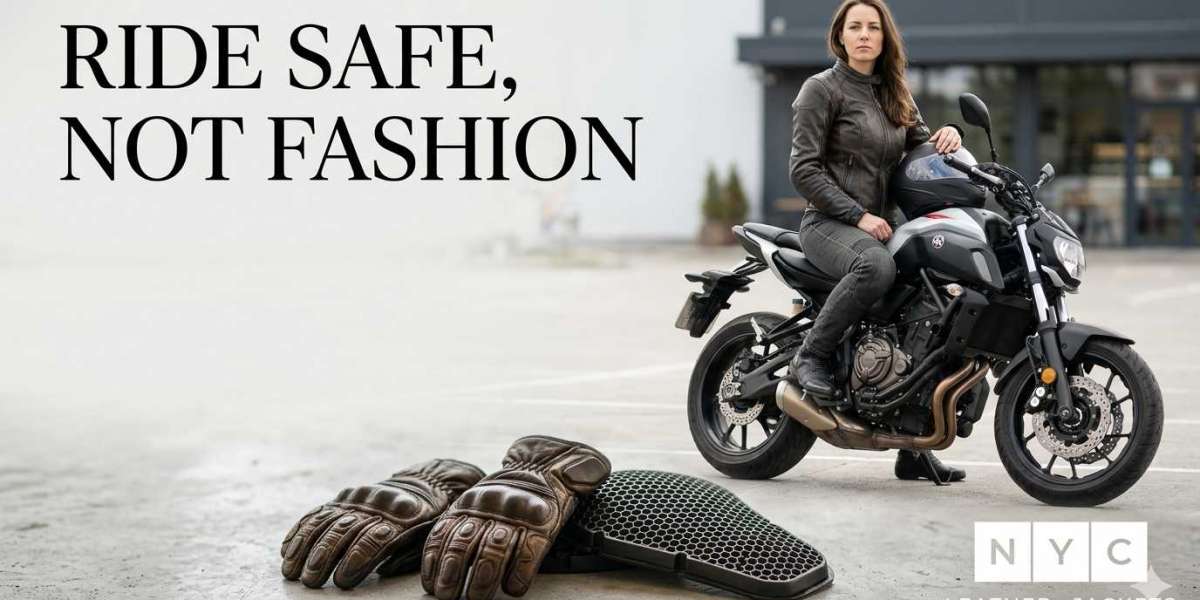

I started riding in my late twenties, on a borrowed Honda Shadow my brother insisted I keep upright in a Costco parking lot before he'd let me on the road. My first jacket was a black asymmetric moto from a high-street fashion retailer that I genuinely believed was a riding jacket because it had zippers in roughly the right places. It was not. The lesson cost me $260 and an afternoon researching why my elbows had no protection whatsoever, which is how I found out what the term CE armour actually meant.
If you're shopping for a womens leather motorcycle jacket and you've been browsing fashion retailers, this guide is the one I wish I'd read first. There is a real and consequential difference between a jacket that looks like riding gear and one that actually performs in a slide. This piece walks through what protective construction looks like, where the fashion industry's marketing language gets dangerous, and how to choose for your specific riding context — including whether you're riding at all.
The line between fashion-moto and riding-rated
The most useful thing I can tell a new rider is that the women's motorcycle jacket category is two categories sharing a name. On one side: jackets sold by fashion retailers, often beautifully made, that take their visual cues from riding gear without delivering any of its protective function. On the other side: jackets engineered for actual motorcycling, often less photogenic, that incorporate impact armour, abrasion-resistant leather construction, and seam reinforcement designed to survive contact with pavement at speed.
The two categories overlap in price. A fashion moto in lambskin can run $400 to $600. A genuine riding jacket from an entry-level moto-specific brand starts in the same range. Cost alone doesn't tell you what you're buying. The construction details do, and most fashion retailers don't disclose them because they're not engineering for that purpose.
What protective construction actually looks like
Three things separate a womens leather jacket for riding from a fashion moto, and any guide that doesn't mention all three is incomplete.
First: leather thickness and quality. Riding-grade leather typically runs 1.1mm to 1.4mm in thickness, often described as full-grain cowhide or specifically as motorcycle-grade. Fashion lambskin runs 0.6mm to 0.9mm. The thicker hide doesn't just feel different — it affects how long the leather resists abrasion in a slide. A general principle in motorcycling safety circles is that thinner hides give up significantly less time before pavement contact reaches the skin. I'd encourage any new rider to read industry resources directly rather than rely on a single number, but the broad picture is that lambskin is not a riding material.
Second: armour. Genuine riding jackets include impact protection at the shoulders, elbows, and (frequently) the back. The standard you should look for is CE certification — specifically EN 1621-1 for limb armour and EN 1621-2 for back protectors. CE Level 1 is the entry-level standard; CE Level 2 absorbs more impact energy and is what I'd recommend for anyone riding at highway speeds. A fashion moto with foam padding that says shoulder protection on the label is not CE-rated armour and provides minimal benefit in a real impact.
Third: seam construction. Riding jackets use double-stitched, reinforced seams designed to hold under the stress of an impact and a slide. The needle pattern is denser, the thread is stronger, and main structural seams often include an additional internal leather strip. Fashion jackets, even quality ones, are stitched for appearance and longevity under normal wear, not for slide resistance. You can sometimes see the difference by turning a sleeve cuff inside out — the inside of a riding jacket usually shows visibly heavier seamwork.
Why most women's motorcycle jackets are still essentially shrunken men's cuts
I want to push hard on something the protective gear industry has been slow to address. The majority of women's motorcycle jackets — even from established moto brands — are designed by taking the men's pattern and reducing it dimensionally. The shoulders narrow. The chest narrows. The waist narrows. But the actual proportions don't change to match how women are typically shaped, which means the armour pockets sit incorrectly, the chest fights at the front zip, and the waist line falls in the wrong place.
This matters more than fit usually does because misplaced armour is less effective armour. If your shoulder protector sits two inches outboard of your actual shoulder joint because the jacket is essentially a small men's cut, the protector won't be where it needs to be in an impact. The same logic applies to elbow armour and back protection.
The brands that pattern from a women's body up — rather than scaling down from men's — have improved over the past five to seven years, but they remain a minority of what's sold. When you're researching, look for explicit language about women-specific patterning, rather than only women's sizing. Those are different claims and the distinction is meaningful for safety performance.
Different riding lives, different jacket answers
What you actually need depends heavily on how and where you ride. The right jacket for a city commuter doing short hops at 35 mph is different from the right jacket for a weekend tourer running interstate at 70-plus.
City commuting at urban speeds: CE Level 1 armour at shoulders and elbows, full-grain cowhide construction, and ventilation panels are the realistic baseline. A back protector is recommended but more debatable at low speeds. Visibility matters — even a small reflective detail on the back or shoulders is worth seeking out. Comfort matters too, because if the jacket is hot or restrictive enough that you stop wearing it, the protection rating doesn't help you.
Weekend touring at highway speeds: this is where the specifications become genuinely consequential. CE Level 2 armour, a CE-rated back protector (often sold separately and added to the jacket's internal pocket), heavier leather, and reinforced seams. The energy involved in a slide at 65 mph or higher is in a different category from a low-speed urban incident. Don't compromise on construction for this kind of riding.
Track days and high-performance riding: outside the scope of this article. If you're riding on a track, your jacket selection should be guided by the gear standards your track requires, by your instructor's advice, and by the gear-fitting expertise of a moto-specific retailer. A general fashion blog is the wrong place to make those decisions.
Honest answer if you don't actually ride
There's a substantial audience for moto-styled jackets among women who don't ride at all. That's fine, and the styling appeal is real. But the language matters, and I want to be direct about it: a fashion moto is a leather jacket with motorcycle aesthetic cues. It is not a motorcycle jacket. Marketing copy that conflates the two is misleading at best and dangerous at worst, because it leaves new riders thinking they're protected when they're not.
If you don't ride and you want the look, buy fashion. The construction trade-offs are entirely reasonable for a style purchase, and lambskin in particular drapes far more beautifully than the heavier cowhide a riding jacket requires. Don't overpay for protective features you won't use.
If you do ride, buy riding gear. The cost differential is usually less than people assume, and the gap closes considerably when you factor in the cost of the road rash, broken collarbone, or worse that quality gear is designed to prevent.
What to look for in product specifications
The clearest signal of a serious riding jacket is specification transparency. Look for product pages that name the leather thickness in millimeters, specify the CE rating of any included armour with the actual standard reference (EN 1621-1, EN 1621-2), describe the seam construction, and detail the armour pocket layout including whether a back protector is included or sold separately.
If a product page mentions only generic terms like premium leather, padded shoulders, or motorcycle-style without backing them up with specifications, treat it as a fashion garment regardless of the marketing photography. The brands that make genuine riding gear are unambiguous about what their gear is rated to do, because they have to be.
On the leather construction side specifically, NYC Leather Jackets has been handcrafting genuine leather women's outerwear since 2005, with material transparency that helps buyers distinguish real cowhide construction from PU or bonded alternatives. Their made-to-measure option is also relevant for women who've been frustrated by the shrunken-men's-cut pattern problem and want a jacket that fits their actual shoulders. For riders, you'll still want to verify CE armour ratings and reinforced seam details directly with any specific product, but having genuine leather construction as a starting point matters.
The mistakes I see new riders make most often
Three patterns come up repeatedly in conversations with women newer to riding.
Buying for the photo. The jacket that looks best in a selfie isn't always the jacket that fits properly with armour seated correctly. Try the jacket on with the armour in place, raise both arms, lean forward as you would on the bike, and check whether the armour actually stays where it's supposed to be. If it shifts, the fit is wrong, and the protection rating is partially compromised.
Sizing for off-the-bike comfort. Riding posture is different from standing posture. A jacket that fits perfectly when you're upright may bind across the back and shoulders when you lean forward into a riding position. The fit needs to work in your actual riding stance, not at the changing room mirror.
Skipping the back protector. Even when a jacket has a pocket for one, many include only foam padding or a low-rated insert. Upgrading to a CE Level 2 back protector is one of the highest-value safety decisions you can make. The cost is usually $50 to $120 separate from the jacket, and the difference in impact protection is substantial.
What I'd tell a friend buying her first jacket
Decide first whether you're buying a riding jacket or a fashion piece, and shop in the right category for that decision. Both are legitimate purchases. The one mistake to avoid is paying riding-jacket prices for fashion construction, or assuming that a fashion moto offers meaningful protection on a real bike.
If you're a new rider shopping for a womens leather motorcycle jacket: prioritise CE-rated armour at shoulders and elbows, look for full-grain cowhide construction over thinner hides, and verify that the women's pattern is designed from a women's body up rather than scaled down from a men's cut. Add a CE Level 2 back protector if your jacket doesn't include one. Don't compromise on these for aesthetics — the gear is doing real work.
If you're not riding, the same advice that applies to any leather jacket purchase applies here: buy what fits, buy what you'll actually wear, and don't pay for features you'll never use. The honesty of that decision saves you both money and the disappointment of a jacket that doesn't quite belong to your real life.


